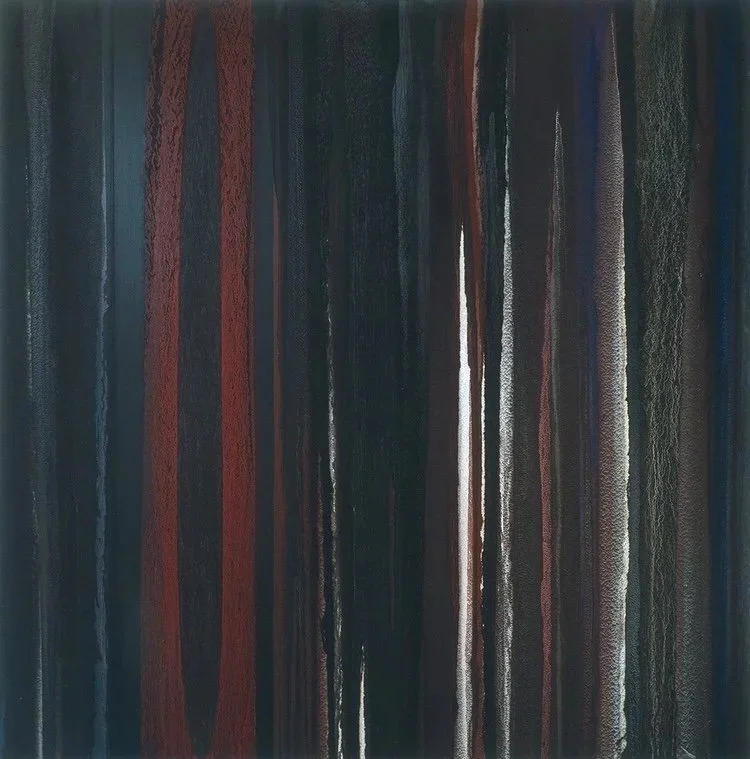
Call of the Colorado Plateau
January 25, 2026 – January 3, 2027
Exhibition: https://musnaz.org/on-view/call-of-the-colorado-plateau/
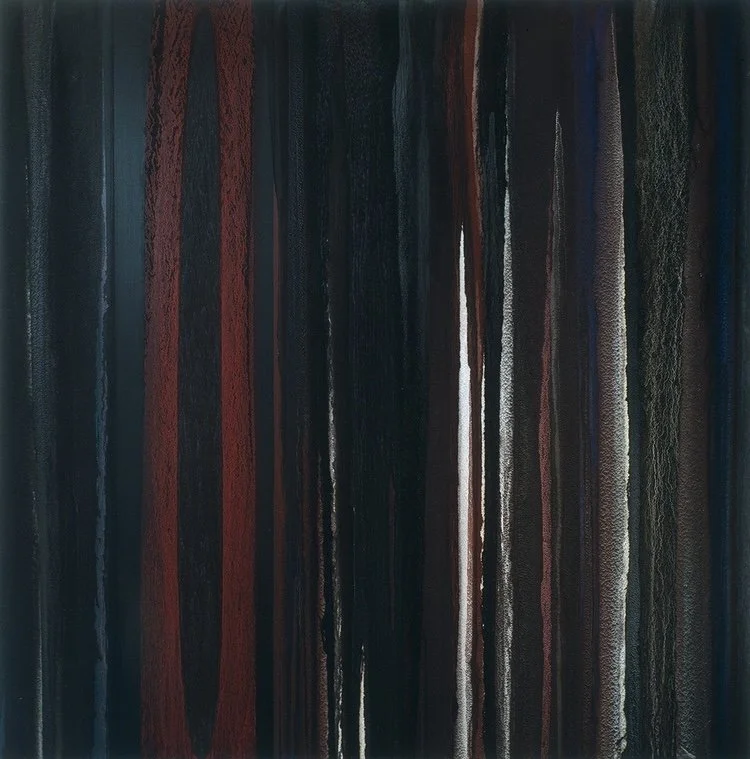
"Vishnu Schist", 96" x 96", by Stephen Auger, Museum of Northern Arizona collection
Vishnu Schist - Stephen Auger
Floating the Colorado through the Grand Canyon, I carried with me a reverberation more ancient than the river’s own voice. The dark, almost black presence of Vishnu Schist at the canyon’s base—its coarse crystals, its quiet, iron-strong gravity—became not just a sight but a memory pressed into the skin of the water and the air around me. To witness Vishnu Schist is to stand at the hinge between time and breath: a Paleoproterozoic heartbeat buried deep in the earth, revealed only when rock meets fire and pressure in the long theatre of tectonic patience. In that moment, the river did not merely carry me along; it translated the 1.7 to 1.9 billion-year story of the crust into a language of color, texture, and scale.
Vishnu Schist, born of ancient volcanic and plutonic beginnings and transformed under heat and pressure, speaks through its dark, lustrous minerals—biotite, muscovite, garnet—arranged by forces that are both intimate and cosmic. The rock’s schistosity, a glimmering alignment of platy minerals, became a metaphor for the way memory aligns itself under pressure: layered, directional, intentional. The canyon’s base, where Vishnu Schist anchors the sequence of time, offered me a ground from which to imagine a painting that could hold both the immediacy of the river and the distant, almost inaudible hum of Earth’s early crust.
The color of Vishnu Schist—deep, extraordinary, almost incandescent in certain light—became my primary vocabulary. I sought to translate that color into a monumental painting: a surface that breathes with mineral hums and geological memory, a landscape that refuses a single gaze and invites complexity. The painting expands beyond itself, attempting to render the canyon’s vertical time into a field where dark planes meet subtle glints of garnet and mica, where mineral textures ripple like water and hold their own memory of pressure and heat. It is not a literal map of rock; it is a communion with the feeling of being present inside a 2-billion-year-old story, at once intimate and overwhelming.
The river’s mobility—its current, its spray, its changing light—taught me about translation. A calm moment on the float can abruptly become a roar of color and mass as sunlight glances off schist facets, or as the river unveils a different facet of the rock’s history with every bend. The artwork seeks to capture that flux: a large-scale painting that refuses to resolve into a single moment or mood, but instead lives in the tension between depth and openness, hardness and vulnerability, the immense weight of deep time and the fragility of present experience.
If Vishnu Schist is the earth speaking through metamorphism, then the painting is my voice listening—an attempt to render not only the color of the rock but the phenomenology of witnessing it: the amplified perception that occurs when a person is carried by a river through a canyon that has existed far longer than any civilization, and will endure long after us. The work invites viewers to stand before a doorway into deep time, to feel the temperature of ancient armor around our own modern lives, and to imagine what it would be like to carry that color, that memory, within us as we move through our own rivers and canyons.
In the end, the painting is not a documentary of a place, but a sculpture of attention: a large-scale response to the extraordinary color of Vishnu Schist, born from a river float, and open to interpretation, drift, and reverence. It is my wish that viewers stand before it and feel, as I did, the gravity of a time long before us and a color that can still astonish the heart into noticing the world anew.
Stephen Auger, Santa Fe, New Mexico